A LIFE, IN CHAPTERS
The life of
Coco Barry.
From a student in Dakar to a life across continents. The choices, setbacks, relationships and achievements behind the photographs.
The people who made home
His parents, his grandfather, his brothers and sister. The faces of home, before a university crowd knew his name.
On the sofa, there is room for a boy on either side of his grandfather. Amadou Barry and his younger brother, Boubacar, sit beside Mamadou Ibrahima Sidibé; cups and a tray rest on the table before them. No score accompanies this photograph. No newspaper has given the afternoon a headline. It has survived for another reason: these people belong to one another.
In a second photograph, their mother, Madeleine Sidibé, smiles at the camera. Years later, when Amadou was preparing to leave Senegal for university in America, another woman would make her a promise. Priscilla Benoit would look after her son. Before he arrived, someone in Maine had given her word to a mother in Dakar.
His full name is Amadou Ibrahima Barry. Coco is the name that followed him into newspaper columns, onto a university court and into the lives of people who had never been to Senegal. To begin with those public achievements would be to arrive late. The story begins here, with Madeleine, Mamadou, Boubacar and the family he grew up among.
Mamadou’s working life belonged to the public service. Senegal’s records follow him from posts and telecommunications into youth and sport: a principal inspector, secretary-general of the committee organising National Youth Week in 1969, inspector-general of state from December 1970, and treasurer-general of the committee administering national football in 1972. A later record places him at the General Secretariat of the Presidency. In 1988 he was named a Grand Officer of the Order of Merit. The titles describe a life of responsibility; the photograph brings us back to a grandfather with a grandson at each side.
Coco grew up with two brothers and a sister. The recruiting coverage of 1985 described his father as a chemical engineer and Madeleine as doing clerical work. Once he was in Maine, she would visit his old school with news of him; a teacher would pass along his sister’s greetings. Distance would make family news slower. It would not make it less necessary.
There are other portraits now: Coco’s father smiling in a light shirt, Madeleine in her younger years, Madeleine at a computer. The photograph at the computer is dated January 3, 1986, at the United States embassy. On its back she writes a few words to her son and signs “Maman”. In another image, she stands beside trophies Coco won. His family remembers her pride. The photographs make room for her own life as well as the part she played in his.
For now, Maine lay ahead. Dakar held his family, his school, the teams he knew and the beginnings of a future he was still choosing. The photographs let us stay there a little longer, before the departures, while the boys are still sitting beside their grandfather.
Read the sources behind this chapter
The user identified the children as Amadou Barry (Coco) and his younger brother Boubacar Barry on November 12, 2026. Mamadou Ibrahima Sidibé had already been confirmed as their grandfather. The date and left-to-right order are not established. Madeleine’s identity and Mamadou’s postal-service identity were previously confirmed by the family. The father’s occupation, Madeleine’s clerical work and the sibling count come from the 1985 recruiting coverage; that coverage does not name the father or siblings. New portraits on pages 18 and 19 were identified by the family as his father and young Madeleine. Her office photograph is dated and located by the handwritten reverse. Trophy ownership and maternal pride are family testimony. No unrecorded age, name or family branch is inferred. New official acts were checked against their page images.
Before the headlines, a student with plans
A school education, a growing basketball talent, and a curiosity that reached beyond the court.
Before Maine’s coaches had seen him play, Coco had already offered a different introduction in a letter. He wanted books, newspapers and magazines. He imagined a cultural club where people could exchange ideas and photographs of their countries. Basketball would soon explain why American readers were hearing his name. His own interests explained why he wanted to go.
At Saint-Michel, Coco had ranked as high as seventh in a class of 53. He had spent years studying English, yet speaking it was another matter. That distinction would become central to his American experience: knowing something on paper did not mean being ready to live through it every day.
On the basketball court, he was growing into another part of himself. Jeanne d’Arc’s cadets came first, in 1981–82; the juniors followed in 1983, then the first team the next year. His later SOPI interview looked back to a performance against Casa as a moment that helped him earn his place. The road to Maine began here, with years of playing and learning in Dakar.
Saint-Michel asked much of its students. Aziz Mbaye, a Senegalese graduate student already in Maine, would explain its demanding academic reputation and strong basketball teams to American readers. He did not know Coco personally, but he knew the school’s standing. Through him, people waiting for this young player began to understand something of the place he came from.
The American columns would compare him with famous African players and speculate about what he might become. In his letters, the ambitions were more particular: things to read, people to meet, countries to understand. That young reader belongs in the story beside the promising center. Both were preparing to leave Dakar.
Read the sources behind this chapter
The choice before the journey
He had an opportunity to play professionally in France. He chose a different kind of future.
A university place on the other side of the Atlantic began with John Benoit bringing Coco to Skip Chappelle’s attention in June 1984. John and Priscilla helped the Maine coach and student-aid director Burt Batty meet him in Senegal, understand his schooling and work across the language gap. There was a player to assess, but there was also a student whose life would have to work when practice was over.
France offered a tempting route. Benoit’s contemporary account described a professional contract with a salary, an apartment and a chance to study in Paris. Coco’s uncle Mamby Sidibé already played professionally there. Maine offered university life in a language Coco knew better on paper than in conversation. He chose Maine. The choice was larger than a preference for one team over another: it would determine where he studied, how he lived and whom he would have to learn to trust.
Chappelle spoke publicly about a young man whose value to the university would remain even if basketball did not work out. The opportunity was being built from both sides of the Atlantic, around the student as well as the player.
Maine reserved an international-student tuition waiver. In June 1985, Senegal’s higher-education ministry supported monthly educational assistance of 65,000 FCFA for the coming academic year. Admission, language preparation, travel and funding all had to come together before Coco could take his place at the university.
Chappelle’s own experience in Senegal helped him understand one part of the challenge. He had needed help communicating in French and could recognize how a capable student might hesitate to speak a language he knew on paper. The coach discussed education and communication between countries as ambitions larger than his basketball program. The relationship was beginning to ask something of the adults as well as the young player.
Thirteen months separated Benoit’s first approach from Coco’s arrival. The newspaper announcement in April 1985 was only one point along that road. Before there could be an airport welcome, there had to be applications, translations, funding and people willing to keep answering the next question. By July, the opportunity had become a journey he could actually make.
Read the sources behind this chapter
A first flight, and people waiting
The journey began with missed connections, unfamiliar directions and a promise to his mother.
His first flight did not carry him neatly from one life to the next. The departure from Dakar was delayed. In New York he missed his connections; Kennedy Airport became hours of waiting. Boston brought more waiting and more directions in a language he was still learning to speak. The journey to Bangor would take roughly seventeen hours.
As Coco tried to find his way north, people in Maine tried to find Coco. An assistant coach and a Maine player searched at Logan Airport. Chappelle and university supporters followed telephone reports that did not quite agree. The carefully arranged arrival had become a succession of calls and uncertainties. Late in the afternoon of July 20, 1985, he finally reached Bangor.
Priscilla Benoit received a hug from the young man who stood six feet eight. “He’s really just a little boy,” she told the reporter. “I promised his mother I would take care of him.” Coco would stay with John and Priscilla until the dormitories opened and begin an intensive English course at Husson. The welcome had a practical form: a place to live, people to turn to, someone who had given Madeleine her word.
Around him were the people who had helped make the journey possible: the Benoits, Chappelle, student-aid director Burt Batty, university supporters and Aziz Mbaye. Their welcome was the first step in a much longer undertaking. A flight could bring him to Maine in a day. Learning to live there would take time.
Chappelle wanted the cameras held back. The university was eager to meet its new player, but the coach asked for space around the newcomer. Coco had just made his first airplane journey, missed connections and arrived in a country where even a simple question could take effort. There would be time to introduce him to the public. First he needed time to settle.
By Sunday morning he had a first impression of America: it seemed very quiet. He was happy, he told the reporter, and very tired. English lessons, campus life and the October start of practice were ahead. Chappelle, relieved by the arrival, understood how much remained. “It’s just starting, too,” he said. “He’s from a long way away.”
Read the sources behind this chapter
Home kept writing
A slow letter could carry an entire world back into view. So could a line on the back of a photograph.
One of Coco’s letters took more than a month to reach Saint-Michel. By November 8, 1985, Frère Emmanuel had received two and was writing back. Between the sending and the answer, days of Coco’s American life had already passed. The envelope could not keep pace with him. It could bring familiar people into the room.
Madeleine had visited the school office with news of her son. His sister was doing well. Didier and Etienne sent greetings. There were elections at the school, changes among the staff and a sports program struggling with its budget. Frère Emmanuel also passed on the death of history teacher Gabriel Boissy’s father. Home had not paused while Coco was away; its ordinary concerns and its grief were continuing.
The school wanted a black-and-white photograph of his new team for STANDARD’s twentieth anniversary. People in Dakar were following the life he had gone to build. The request gave him something to send back: a picture of the team, a glimpse of the university, evidence of the place now filling his letters.
Priscilla’s welcome had helped him arrive. Madeleine’s visits to Saint-Michel and Frère Emmanuel’s reply helped the connection survive the distance. Each knew a different part of his life. The correspondence brought those parts within reach of one another.
Madeleine wrote too, on the back of a photograph. On January 3, 1986, she turned from a keyboard to smile at the camera. She wrote where she was, and who she was to the person who would read it: at the United States embassy; his mother, who loved him. Beneath the date and the place, she signed “Maman”.
On March 27, 1987, his grandfather wrote from Dakar. His note does not mention basketball. He asks Coco to work well, to prepare for the difficulties of life, and not to disappoint the mother who had done so much for her children, and for him especially. He had written “ta chère” and continued the sentence; the word “mère” is added above the line. At the end come encouragement and confidence: “Bon courage et bonne chance.” He signs “Ton grand père”.
An undated postcard holds another voice. Across a photograph of a carriage in Saint-Louis, his father wished him health and success and promised a longer letter. “Ton père qui pense à toi,” he signed it: your father, thinking of you. The date is lost to the record. The wish to keep the conversation going is still there.
On the back of another portrait, an unnamed writer wishes him success in basketball and in his studies. Both hopes fit into a single sentence. A teacher’s letter, a mother’s photograph, a grandfather’s counsel, a father’s card: each knew a different part of his life. Their words kept those parts within reach of one another.
Read the sources behind this chapter
The November 1985 letter does not establish how Didier and Etienne were related to Coco. They are introduced only as people sending greetings. The office photograph is dated January 3, 1986 by its reverse; the grandfather’s portrait note is dated March 27, 1987. The Saint-Louis postcard is undated and signed by the writer as Coco’s father. The separate two-page letter is not used to introduce new family milestones.
A long way from the headlines
Injury, language, weather and expectations made adaptation an everyday task.
On August 26, 1985, Chappelle’s preseason letter welcomed six returning veterans and eight new candidates. It promised work on strength and stamina, with difficult opponents ahead. Coco had arrived in time to begin, but an August stress fracture kept him from joining the preparation as he had hoped. The team was learning to move together. He was waiting to get well.
There was one glimpse of what he could do: six points and three rebounds against La Salle. Then another injury interrupted his season. So much attention had preceded him that the absence became part of the story almost at once. His first American basketball year was turning into something no announcement could have prepared him for.
Off the court, even getting to class could become an adventure. A power outage upset his alarm. Thinking it was half past seven, he dressed and ran to class, only to find the door locked and no one there. It was not yet six. He returned to the dormitory. That door was locked too, and no one answered the phone. Later he could laugh as he told it. The recollection ended somewhere less amusing: “I was never so cold. I missed Africa so much.”
Snow supplied its own lessons. “I fall down all over the place,” he remembered. “I stand up, I fall again.” Snowballs followed. His cotton clothes, poorly suited to the winter, were once mistaken for pajamas on the way to class. The first-year account preserves these moments in his own amused telling, alongside the frustration of being injured so far from home.
He found a more ingenious answer to unwanted conversations: the Walkman. Near graduation he recalled wearing headphones so he could pretend not to hear people calling to him. Years of English lessons had not made every exchange easy. The headphones offered a temporary escape. Coursework allowed no such shortcut. He recorded lectures, played them back a little at a time and worked with a French-English dictionary. An assignment that took another student an hour, he said, could take him five.
The team required another kind of translation. He had to understand the system, make himself understood and earn a place among players with ambitions of their own. Chappelle’s unusual investment in him could create strains. Recovery and belonging were proceeding at different speeds, and neither was finished.
Dormitory life also brought things he did not accept. In the first-year feature, Coco described drinking, damage and repair charges shared among residents, including people who had not caused the damage. He said he neither drank nor smoked. Those convictions would later travel with him into school classrooms, where young people would hear him speak.
On April 4, 1986, a hardship waiver restored a year of basketball eligibility. It gave him time that injury had taken away. The ambition he voiced was plain: he intended to graduate. A season could be interrupted. The education was still there to be earned.
Read the sources behind this chapter
Learning to be heard
His voice became a bridge between Senegal and the young people he met in Maine.
At Brewer High School on March 14, 1986, the plan was modest: two advanced French classes would hear Coco talk about Senegal and his arrival in America. Claudette O’Connell listened, then asked him to stay. More students came. By the end of the visit, approximately 150 had heard him. A young man who had sometimes hidden behind headphones was now being asked to keep talking.
O’Connell’s letter wanted his family to know how highly the school thought of him. At Center Drive School, principal James H. White praised his progress in English, his wit and his standards. In a June 23 letter to Chappelle, White called him “a student first, and an athlete second.” The phrase gave the university’s celebrated recruit an order of priorities Coco could recognize.
His subjects came from his own convictions. He was proud of Senegal and wanted students to understand it. He was troubled by the drinking and destructive behavior he had encountered in dormitory life, and he spoke against alcohol and drugs. Later, a mother told him that her daughter had taken his message so seriously that she had poured away her father's wine. The mother thanked him. Coco remembered it as the story that made him want to keep speaking.
The work continued. A Kids & Kops sweater letter in January 1987 recognized his example for young people. A certificate records his appearance at Indian Island School's basketball banquet in March 1988. Near graduation, the newspaper described visits extending from Orono to Rockland. The young man who had once hidden behind his headphones had become someone schools invited back.
These were achievements the season’s statistics could not record. Injury still disrupted his basketball, yet in front of a class he could hold the room. The letters let Madeleine and the people at home hear something beyond reports of games and recovery: her son was finding his voice, and other people wanted to hear it.
Read the sources behind this chapter
The work behind the improvement
Confidence arrived through repetition, responsibility and the chance to play.
The excitement surrounding his arrival had been loud. So, at times, was the disappointment. Injuries and uneven play made Coco an easy target for spectators frustrated by Maine’s struggles. Mike Dowd’s account of his second year remembers both the expectations and the criticism. Behind them was a student still learning a language, a new way of living and a different game.
Before the regular practices came the smaller sessions with Chappelle. The coach and player worked on skills that a crowd would notice only when they went wrong: catching a pass, choosing a move, finding a position that helped the offense. Improvement meant returning to them before another practice, then another game.
There were basketball-specific differences to learn. Contemporary reports describe his adjustment to physical play around the basket and to the positioning required by the American college game. Catching the ball, choosing the next move and finding a useful place in the offense all demanded attention. He would later explain that he sometimes tried to begin a move before the pass had reached him. Learning to slow that moment down was part of becoming more effective.
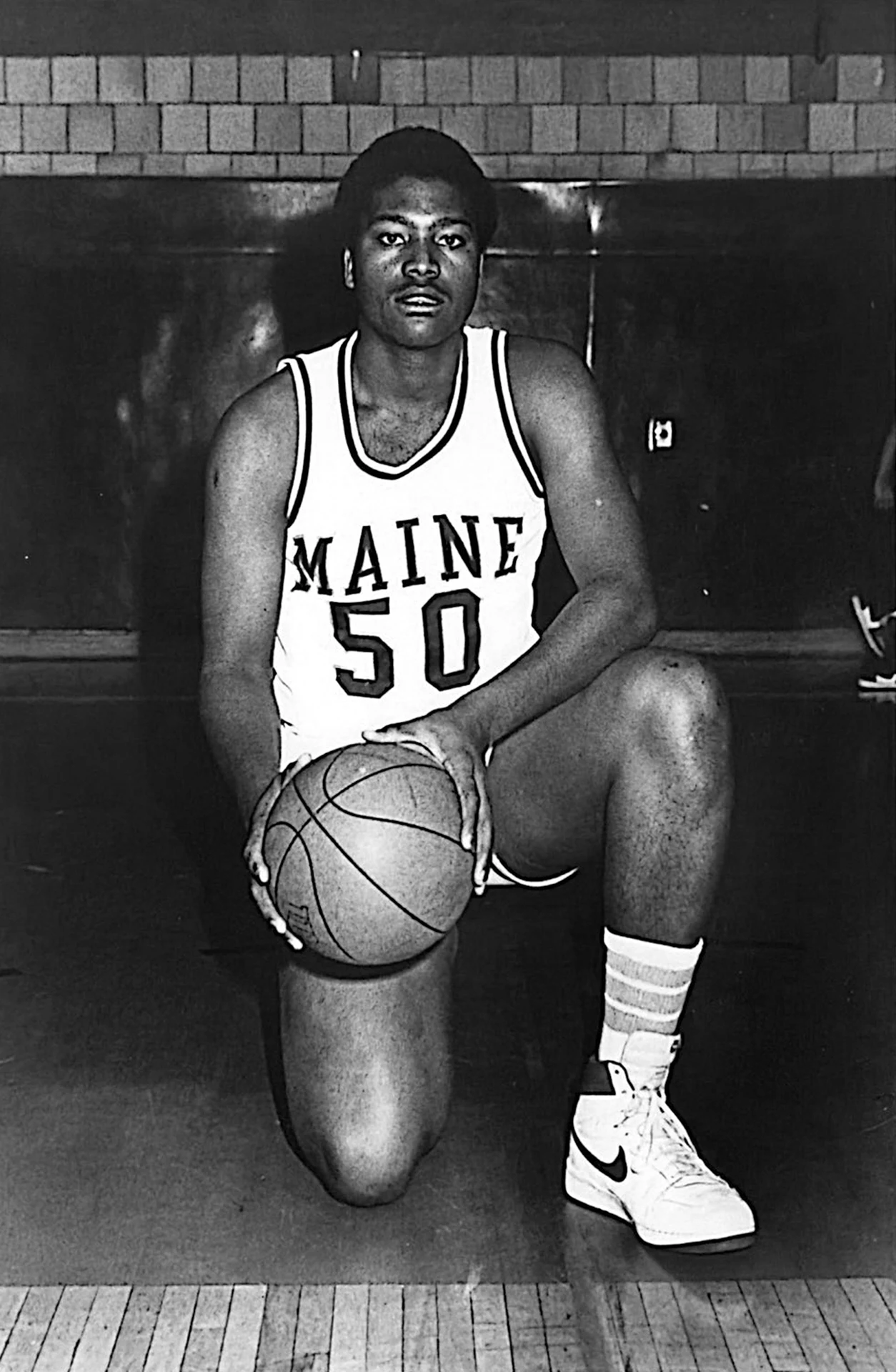
Against Colgate on January 31, 1987, those developments became a clear result: seventeen points and eleven rebounds in an 83–66 victory. He scored twice on offensive rebounds during Maine’s early run. When Colgate threatened later, his free throws helped the Bears pull away. Opposing coach Joe Baker acknowledged that Coco had become a much larger factor than earlier observations had led him to expect.
The win was collective. Jim Boylen scored twenty-four, Dean Smith supplied fifteen and Mike LaPlante made important defensive and supporting plays. Coco’s emergence mattered because it gave those teammates another reliable contributor. The official conference record lists a Rookie of the Week honor and a place on the 1986–87 All-Rookie team. Maine’s historical table also identifies him as the team’s rebounding leader that season.
The year still ended in defeat, against Boston University in the conference tournament. Improvement had not made the game easy or turned Maine into an unbeatable team. It had made Coco a contributor his teammates could use. After the season spent largely waiting, that was a consequential change.
Read the sources behind this chapter
A person young people could recognize
School invitations and community recognition became a continuing part of his university life.
The school visits continued beyond the first appreciative letters. Near graduation, the reporting would describe Coco speaking to young people from Orono to Rockland. He talked about Senegal and about his own standards, using the visibility of basketball to reach audiences who were not there to watch a game. The role asked him to translate his experience into something a child or teenager could understand.
For schools, his appeal reached beyond his height or his place on the team. The earlier letters had praised his humor and his ability to hold a room’s attention. He could speak about a country many of the children had never seen, while also speaking about the choices they faced in their own lives.
The Basketball Boosters kept a place for this work alongside the games. A letter dated January 22, 1987 accompanied a Kids & Kops All-Star sweater and thanked athletes for the example they set for young people. Years later, Bangor Daily News would remember Coco among the original campaign’s athletes. A contribution made during college had remained part of the community’s memory.
On March 29, 1988, he was the guest speaker at the basketball banquet of Indian Island School, a school of the Penobscot Nation. Brewer, Center Drive, Indian Island: the names mark a widening circle of classrooms and young people who came to know him.
A child might first recognize him from basketball. In a classroom there was time to know something else: where Senegal was, what it meant to arrive in America, why he cared about the choices young people made. The invitations continued because he had something to offer after the introduction was over.
Read the sources behind this chapter
The January 22, 1987 Kids & Kops letter has a generic salutation. Coco’s association with the original campaign is also supported by the 2015 Bangor Daily News retrospective; that article does not establish a new appearance in 2015.
Two countries in the same season
Maine became part of his life without replacing Senegal.
In December 1987, Maine played Fairleigh Dickinson with two familiar places in its lineup empty. Coco and Guy Gomis were in Tunisia with Senegal’s national team. The Black Bears lost 74–60. For their absent teammates, the college season had opened onto another allegiance: the country they had left to study abroad.
Guy belonged to both parts of his life. They had been school rivals in Dakar; in Maine, they became teammates. Coco arrived first. When Guy followed a year later, there was someone who understood the language he had left behind and the place he was trying to enter. The newcomer of the previous year could now help another young man find his way.
Their paths would remain close through basketball and university life. They played for Maine and continued their involvement with Senegal’s national team. By graduation, they were helping lead an African Students Association, creating a community that joined something of home to the place where they were studying.
Earlier in the season, both had played in a different meeting with Fairleigh Dickinson, a 70–64 loss in which their defensive work drew attention. The later game took place during their national-team absence. On one page, they were working for Maine; on another, their empty places in the lineup pointed toward Senegal.
On earlier pages, Coco and Guy had defended together for Maine against the same opponent. In December, their absence told the other half of the story. The American university and the Senegalese national team both had a claim on their time. For Coco, belonging to Maine had never required leaving Senegal out of his life.
Read the sources behind this chapter
The contemporary December 1987 game report establishes Coco and Guy’s national-team trip to Tunisia. The later French feature’s international-event references do not establish a complete appearance or medal record. No additional tournament honors are asserted.
What he wanted to carry home
In the SOPI interview, Coco explained the work and the possibilities in his own terms.
Back in Senegal, readers wanted to hear how he was getting on. In an interview for SOPI, Abou Abel Thiam gave Coco room to answer in his own words. The player whose arrival had filled American columns could now tell people at home what life in Maine actually asked of him.
He recalled the cultural shock and the language barrier. He described intensive coursework, regular team practice and additional individual work with Chappelle. The coach’s support appears here as a sustained part of his development, not simply a recruitment story repeated by American newspapers. Coco was explaining the daily demands behind the player his home audience now saw.
Away games carried homework with them. In the SOPI interview, Coco described recorded classes, study in hotel rooms and calls to professors when an explanation still escaped him. A team bus could take him off campus. It could not take him out of the course. The classroom had to travel.
The interview also turns outward. Coco argued that Senegalese players had technical ability and needed stronger material support, physical preparation and investment to make a future in the sport possible. Having experienced another system, he was thinking about what could help players at home.
Years before, he had imagined exchanging ideas and pictures with people from other countries. Now he had something of his own to bring to that exchange: experience earned through difficult days, a growing knowledge of the game and a belief that young players in Senegal deserved the means to develop their talent.
Read the sources behind this chapter
Twenty-seven points, and a thank-you
The meaning of the performance begins in an office the evening before the game.
On Friday, January 15, 1988, Skip Chappelle told his players he would step down when the season ended. He had coached Maine for seventeen years. The current season offered little consolation: two wins, eight losses, and no victory since December 12.
Early that evening, he was in his office at Memorial Gymnasium, preparing to go home, when Coco came in.
Coco had come to say thank you. The words would not come easily. Chappelle had helped bring him from Dakar, encouraged him through injury and worked with him when improvement was slow. Coco later remembered the Sundays when the coach could have been home with his family but came in for individual practice instead. In the office, trying to express what that care had meant, he began to cry.
“He’s been my backbone here.”
Coco, speaking about Skip Chappelle in Gregory Betts’s feature
“I’m not so tough that it didn’t affect me, too,” Chappelle told Gregory Betts a few weeks later. He remembered the visit as an expression of affection, of what they had been through together. There was still a season for them to finish together. Tomorrow, there was a game to play.
The next afternoon, 1,025 people came to Memorial Gymnasium, The Pit, for Maine’s game against Canisius. The visitors had three centers, each six feet nine or taller, to put against him near the basket. Maine began awkwardly, missing shots and turning the ball over. At halftime the Bears trailed 37–35. With 13:42 left, they were still behind, 48–45.
Then Guy Gomis missed a shot, and Coco claimed the rebound. Fouled on the play, he made both free throws. On Maine’s next possession he scored from close range. The lead was 49–48. Maine would not give it back. The pressure he created inside drew defenders toward him; Jeff Holmes found room for two three-pointers. Todd Hanson helped direct the offense. Before nine minutes remained, Maine had pulled ahead 63–50.
Canisius came back within five. Coco answered with another basket, this one from a Reggie Banks pass. Banks then helped finish the afternoon with a succession of dunks. His twenty-four points belonged beside Coco’s twenty-seven, just as the twelve each from Gomis and Holmes belonged in the story of the win. The final score was 94–84.
Twenty of Coco’s points had come after halftime. He also had fifteen rebounds and two blocked shots, in what the reports called his finest college game so far. With 1:06 remaining, he fouled out and had to watch his teammates complete it. Maine’s first conference win of the season ended a four-game losing streak.
The relief left room for a joke. “If I had known this would happen,” Chappelle said, “I would have retired after the Michigan State game.” Coco’s explanation made room for everybody: “We did it for him and we did it for ourselves.” Then the practical truth: “We needed a win.”
Two days before Canisius, Coco had scored fifteen points and taken six rebounds against Northeastern. The two performances—forty-two points, twenty-one rebounds—brought conference Player of the Week recognition. The skills behind that week had been built long before the retirement announcement, through practices, setbacks and the patience of learning a move until he could trust it.
Weeks later, Coco found words for the relationship that had overwhelmed him in the office. “He’s been my backbone here,” he told Betts. Chappelle was the person he could approach for advice, someone with whom he felt at ease. “For me it’s very hard to see him go,” he said, “because I really love him.”
Read the sources behind this chapter
Making the breakthrough last
The next weeks showed that his progress could change more than one afternoon.
A great afternoon did not spare him the next difficult game. After Canisius came twelve points and twelve rebounds against Hartford, and a 50–48 defeat. Eighteen points and thirteen rebounds against Siena could not secure a win either; in an earlier loss to Siena he had finished with seventeen and eleven. Coco’s contribution was growing steadier before Maine’s results did.
Opposing coaches were noticing. Mike Deane of Siena acknowledged how much Coco had improved. His teammates were noticing too. Jeff Holmes told a reporter that he had once doubted how good Coco would become and was now seeing himself proved wrong. The late-February feature describes defenses beginning to double- and triple-team him, creating openings elsewhere for Maine. He was becoming someone the other team had to plan around.
In February, Maine met Canisius again, this time away. The game stretched into two overtimes before the Bears won 99–96. Coco scored sixteen, while Reggie Banks and Jesse Forester each scored twenty-seven. It was another night to remember, earned together and far from the home floor where January’s thank-you had unfolded.
The strongest sustained stretch came against Colgate and Vermont. Coco recorded twenty-one points and twelve rebounds in an 80–66 win at Colgate. He then supplied fourteen points and thirteen rebounds in each of two wins over Vermont, first 75–74 away and then 85–80 at home. The three games added up to forty-nine points and thirty-eight rebounds. A second conference Player of the Week honor followed, supported in the archive by both a certificate and the newspaper notices.
Against Boston University at home, he scored fifteen of his seventeen points before halftime and collected eleven rebounds as Maine won 91–75. The Bears won the rematch 70–67 in Boston, then beat New Hampshire 86–68 to extend their winning streak to six. Coco’s inside play was part of a team resurgence that brought renewed excitement to the local sports pages.
The reports also preserve the limits and the help he needed. He fouled out of the Boston rematch, and teammates had to finish the job. Northeastern ended the six-game run despite his twelve points and fourteen rebounds. Hartford then spoiled Chappelle’s final home-game tribute, with Coco scoring thirteen in the defeat. The farewell contained a ceremony and a loss, affection and disappointment together.
The last weeks refused a tidy farewell. There was a six-game winning streak, then its end; applause for Chappelle, then a loss on the night of his home tribute. Coco’s own season held foul trouble beside dominant afternoons, teammates finishing what he could not finish, and rebounds claimed in games Maine still lost. By its end, no one in the conference had averaged more of them.
Read the sources behind this chapter
The recognition he earned
The certificates preserve the formal achievements. The letters show what people saw behind them.
After the newspaper excitement came the mail: a certificate, a letter of congratulations, the university’s varsity M. The family kept those too. Their formal language records the moment a season’s work became something Coco could hold in his hands.
His second Player of the Week honor followed the three victories over Colgate and Vermont in February 1988. A conference certificate also named him for honorable mention at center on the 1987–88 All-Star team. The student who had spent so much of his first year recovering now had a place among the conference’s recognized players.
He finished 1987–88 with 253 rebounds in twenty-seven games, an average of 9.4 that led the North Atlantic Conference. Maine’s later tables show him as the university’s leading rebounder in three consecutive seasons, from 1986–87 through 1988–89. A rebound gives a team another possession or ends an opponent’s chance. Repeated that often, the work becomes central to how a team survives a winter.
On March 10, university administrator Thomas D. Aceto wrote to congratulate him. The letter recognized his basketball honors and his developing leadership, then looked toward his academic work as well. Even in a season of athletic recognition, the student remained in view.
The varsity M certificate followed on March 25. Together, the letters and awards trace the distance from the injured newcomer to a player trusted with responsibility. There was more to achieve, and a degree still to finish. But the work was being seen.
The numbers also found their way into a private message. Someone signing as his number-one fan congratulated Amadou on his successes, teased that they could still beat him one-on-one, and recalled “the night of 27/15”. Below the jokes came encouragement to think positively and believe in himself. The writer remains unnamed. The note, marked 1989, keeps something the certificates cannot: the voice of someone cheering for him.
Read the sources behind this chapter
The weekly certificate gives the period ending February 20, 1988; the historical conference list uses February 21. These refer to one honor. Partial duplicate certificates are retained without counting extra awards. The final 253 rebounds / 27 games / 9.4 average supersede in-season running averages.
Learning to matter in a different role
A new coach changed the system. Coco learned how to contribute within it.
Rudy Keeling’s arrival began a different basketball chapter. The preseason articles described a faster style, changes in the program and a deeper bench. Curtis Robertson was starting at center; Coco, who had been a starter, now had to find his place as a reserve. The change was not simply a smaller version of his earlier role. He was learning another coach’s expectations and becoming useful at both center and power forward.
The bench gave him a view of the other team before he had to contend with it. He studied, waited and prepared to enter. “It doesn’t matter who starts the game,” he explained in January. The remark did not make the change of role disappear. It stated where he had decided to put his attention: on being useful when the game needed him.
The results gave that view substance. An earlier twenty-point, nine-rebound performance against Providence had strengthened his confidence. At Boston University on January 11, he made eight of nine shots and finished with seventeen points and ten rebounds in thirty-five minutes off the bench. Maine still lost 83–68, but his shooting over four games had reached twenty-two baskets from twenty-seven attempts.
“It doesn’t matter who starts the game.”
Coco, in Pat Borzi’s January 12, 1989 feature
Pat Borzi’s feature, “Red-hot Coco,” describes a player becoming more secure in receiving a pass, turning and finishing. It also gives his teammates a part in the explanation: Coco said their belief in him made a difference. Keeling spoke about demanding more from him. As Coco left the locker room, he reconsidered a question about working harder and acknowledged that perhaps he wanted improvement more urgently that year.
At New Hampshire, he scored twenty-two points and took eight rebounds, making nine of eleven shots. Eight consecutive points helped Maine turn a second-half deficit into a lead and go on to win. Once more, the player coming from the bench changed what was possible on the floor.
Against Niagara at home, he supplied fifteen points and eight rebounds in a 56–47 win. Twelve points came after halftime, including nine in the final six minutes and twenty-four seconds. That closing contribution is a clearer explanation of his value than the label “reserve.” He had learned to be ready when the team needed an inside basket, a rebound or a different combination on the floor.
Read the sources behind this chapter
The two saved New Hampshire reports disagree on the final team score. Both establish Maine’s victory and Coco’s 22 points, 8 rebounds and 9-of-11 shooting. The disputed team score is left out of the narrative.
The work that makes a team
Some of the important contributions sit inside somebody else’s headline.
Marty Higgins’s last-second basket beat Northeastern on January 28, 1989. Maine won 73–71, and the freshman guard’s long drive and running shot supplied the headline. Look a little earlier in the play, through Higgins’s own account, and Coco is there too: a pick-and-roll between them, a defender falling behind, an opening Higgins could take.
Earlier, Coco had made two late free throws after Northeastern regained the lead. Guy Gomis blocked six shots; Matt Rossignol scored twenty-two; Dean Smith added thirteen. Foul trouble and an injury to Curtis Robertson had forced changes around them. Higgins’s winning shot was the final moment of an effort many hands had helped to hold together.
At Niagara, a sinus infection had kept Coco out of practice. He played anyway, finishing with fifteen points and seven rebounds as Maine won 64–53, its first victory at that venue. Late in the game, Reggie Banks blocked a shot. A fast-break attempt missed. Coco followed, gathered the rebound and scored. When the first chance fell away, he was there for the next one.
The collection also preserves the disruptions around the games. Boston University won a separate home meeting 64–49. A measles outbreak interrupted the season and led to plans for a game without spectators. One report followed teammate Matt Rossignol’s concern for his pregnant wife, Monique. The players were living through those uncertainties as they tried to finish their season.
Maine closed the regular season by beating Vermont 83–81 on March 4. Rossignol’s late free throws decided it; Coco contributed fifteen points, with a later preview crediting him with nine rebounds. The renewed optimism did not survive the conference tournament: Northeastern won 65–59 on March 9, ending the 1988–89 team season at 9–19.
Coco still had another college season ahead. The family’s thick run of game clippings grows thinner here, but the university records continue through 1989–90. There was still basketball to play, coursework to finish and a promise to keep.
Read the sources behind this chapter
The photograph in graduation robes
The education he had insisted on completing finally takes the foreground.
Four men stand in the graduation photograph: John Benoit, Guy Gomis, Coco Barry and Skip Chappelle. Benoit and Chappelle had helped bring Coco to Maine. Guy had made a life there alongside him. The robes give the occasion its name. The people give it a history.
By then, he had become someone others could turn to. Guy had arrived a year after him, able to rely on a friend who knew the difficulties of beginning again. Together, they helped create an African Students Association with thirty-five members. Coco served as vice president; Guy was treasurer.
Before leaving Dakar, Coco had written that he wanted a club where people could exchange ideas and photographs of their countries. Years later, that wish had taken the shape of a community. He had found people with whom to share something of home, and a way to introduce it to others.
Around 1990, he earned his degree in political science. The long evenings with lecture recordings and a dictionary had led here. So had the days that held both coursework and three hours of basketball. Chappelle took pride in seeing his players finish their eligibility and complete their degrees soon afterward. He had helped bring students to Maine. They were leaving with an education.
Coco was already looking forward. He spoke of a possible MBA, of marriage and of his continuing relationship with Senegal. Those were hopes for the years ahead. The achievement before him was real and present: he had crossed an ocean, learned to study in another language, played for his university and his country, and made a life among people who had once been strangers.
In his difficult first year, Coco had said he would graduate. He had spoken of the responsibility he felt toward family and country. By the time this photograph was made, the declaration had become a degree. The young man who once replayed his lectures with a dictionary could stand with the people who had helped him begin and count the education as his own.
Read the sources behind this chapter
The graduation features are undated, so the chronology uses “around 1990.” The American feature anticipates commencement; the French article describes completed diplomas. His family-confirmed professional profile also records the Maine political-science degree. The MBA and marriage mentioned in those articles were plans, not documented completed events.
A connection that outlasted the team
The institutional record and later reporting extend the story beyond the saved game reports.
At the end of his Maine career, Coco had played ninety-seven games and gathered 649 rebounds. The university’s Athletic Almanac lists four varsity letter seasons, from 1986–87 through 1989–90, and places him with the class of 1990. The totals give a lasting shape to years that had begun with injury and uncertainty.
The connection to Senegal continued within Maine basketball too. A later article by Pete Warner and Larry Mahoney describes Mike LaPlante helping bring Mamadou N’diaye and Ndongo N’diaye to the program. LaPlante had been part of the team environment preserved in Coco’s own game reports. The later article looks back to the opening created by Chappelle’s recruitment of Coco and Guy about a decade earlier.
The later players had their own journeys, and LaPlante did the recruiting. What the retrospective recognized was the earlier opening: Chappelle’s relationship with Senegal, established through Coco and Guy, had endured. An arrival once followed through anxious airport calls had become part of the program’s history.
The community kept another memory of him. When Bangor Daily News looked back at the original Kids & Kops campaign in 2015, Coco was among the athletes it recalled. The rebounds remained in the record books. His example to children had a place in the memory of Maine, too.
His own life would carry on across another border. The next chapters take us to Canada, to Montréal and to the teams he would help build in his working life. There are years between graduation and those later roles that the saved papers cannot fully tell. They belong to the memories still to be shared.
Read the sources behind this chapter
Building teams beyond basketball
The Canadian chapter brings a different setting for responsibility, learning and leadership.
The Canadian chapter comes into view through a different record: stores, regions, teams and responsibilities rather than opponents and final scores. Coco’s professional résumé places him at Best Buy Canada as a general manager from 2004 to 2006, then at Rogers as an area manager from 2006 to 2011. These were new settings for the work of helping people perform together.
Bouclair followed from 2011 to 2014, with responsibility for regional sales. At OSL Retail Services from 2014 to 2020, his region covered Quebec and Ottawa. His later account records a regional sales role in Eastern Canada with Mobile Klinik beginning in 2020 and a national account sales role with Cydcor Canada beginning in 2024. The dates trace widening responsibilities without telling us every turn in the years between them.
In 2019, in the midst of that working life, he completed a certificate in emotional intelligence and leadership at HEC Montréal. Nearly three decades separated it from the Maine degree. Education had once required an ocean crossing and a dictionary beside the recorded lectures. Now it concerned the work of understanding and leading other people.
The job titles describe the scope of his work. His colleagues describe how it felt to work beside him. Their accounts bring the story back from the résumé to the person.
Read the sources behind this chapter
The career timeline reproduces positions in Coco’s family-confirmed professional résumé. “From 2020” and “From 2024” indicate listed start dates, not independently verified current employment. The résumé lists the 2019 HEC Montréal certificate in emotional intelligence and leadership.
The leader his colleagues describe
Colleagues add a human perspective to the sequence of job titles.
Ask the people who worked beside him, and the job titles give way to a person. Daniel Epp remembers a colleague who shared what he knew, stood up for his team in French and English, and earned loyalty through empathy. Greg Bedard recalls helping build a team in Quebec with Coco and the trust he brought to those relationships.
The later professional chapter also includes an association with Electro Pompe CM and a service-improvement project beginning in June 2026. The work changes, and the story continues to find new settings.
These recollections belong beside the early Maine letters. There, teachers wrote about a newcomer learning to speak to a room. Here, colleagues remember a bilingual leader making room for others. The settings and responsibilities have changed. Read together, the accounts show how much of a life is revealed in the way other people remember working alongside it.
“a passion for cultivating trust-based relationships”
Greg Bedard, in a public professional recommendation
Coco is still more than any one of these accounts can contain. The player, the student, the visitor to a school and the colleague each appear because someone took the trouble to write. Their words meet here, across years and countries, without bringing the journey to an end.
Read the sources behind this chapter
Daniel Epp’s and Greg Bedard’s descriptions are attributed professional recommendations. The public profile and company page support the Electro Pompe CM association and the listed June 2026 service-improvement project; they do not establish a precise job title or employment start date.
The life held in the family album
Some of the most important photographs do not come with headlines or dates.
After the last newspaper page, there are still photographs to turn over. People gathered indoors. A child beside an adult. Formal clothes, familiar rooms, a smile held for the camera. A life continues around its public occasions, in moments that no reporter is there to record.
Madeleine smiles again. Mamadou sits with Coco and Boubacar beside him. Returning to these photographs after the newspaper years changes the scale: the player whose rebounds filled columns is also the boy beside his grandfather, the son whose mother brought news to Saint-Michel.
The family kept more than achievements. An inscription addressed to Coco and signed with love. Letters, tickets, a professional card. More than one print of a photograph. Small things that made it through the years because someone chose to keep them.
Eighty-six family photographs sit alongside the school, campus and basketball pictures. They bring the story back to its private scale. The man in the sports pages also belonged to rooms like these, to shared occasions, to the people just outside the frame.
The album remains open. There are names to add and occasions someone will remember as soon as they see the picture. There are years still waiting for their storytellers. From Senegal to Maine to Canada, Coco’s life has brought him among many people. Here, there is room for them to speak.
A few more dates now come from the backs of the photographs themselves. One reads “3/07/90. Jour de la Tabaski.” Another records a reception at the ambassador’s with the Navy Band on May 15, 1991. The people in those frames are not all named yet. The inscriptions let the occasions take their place without asking the pictures to tell more than they know.
Read the sources behind this chapter
THE STORY CONTINUES IN THE COLLECTION
Look closer.
There is more to discover.
The complete source collection brings together 200 photographs and 137 clippings, letters and documents. Read the original pieces, explore the family album or follow the basketball seasons in detail.