1985–86The first winter
He waited.
A stress fracture in August. Then a first glimpse: six points and three rebounds against La Salle. Then another injury. The player everyone had been waiting to see spent most of that season getting well.
Dakar · Maine · MontréalA life
Amadou Ibrahima Barry
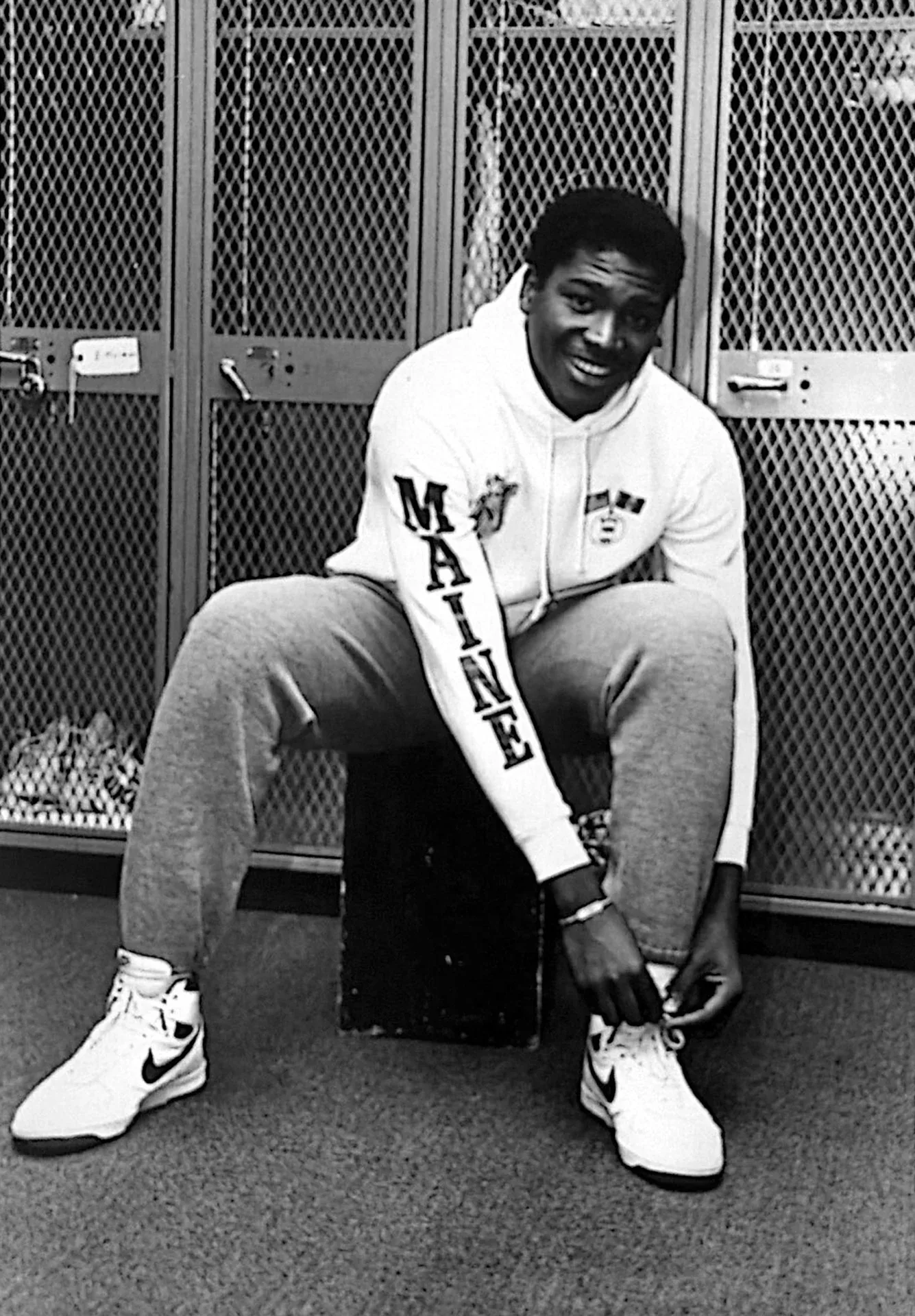
A young man from Dakar crosses an ocean for a classroom. The game goes with him. So does home.
Dakar — Maine — Montréal
A short film · 66 seconds · with sound
The story began at home.
Selected portraits are animated with AI from family photographs. The original images remain in the archive. Music is an original ambient score; there is no historical recorded speech or game footage.
I Home
Madeleine Sidibé, his mother, smiles from a photograph the family kept. In another, two small boys sit close beside their grandfather, Mamadou Ibrahima Sidibé. One of them is Coco. The other is his younger brother, Boubacar.
His full name is Amadou Ibrahima Barry. To the people who know him, he is Coco—a name carried across an ocean, from the family home to a new life in Maine.
Mamadou spent his working years in public service: Senegal’s postal administration, and later the General Secretariat of the Presidency. The picture the family saved is a quieter thing: a grandfather with a grandson at each side.
What the card says, and why it matters
A card like this is usually a name and a job. His holds the work of a lifetime in Senegal’s public service, and the two highest orders of the republic.
This is the man on the sofa with a grandson at each side. The boy on his left would carry the same first name across the ocean.
Some photographs came with a message.
Home, in their own handwriting.
II Dakar · 1981–1985
At Saint-Michel he ranked as high as seventh in a class of fifty-three. At Jeanne d’Arc he rose from the cadets to the juniors to the first team.
In his letters he asked for books and magazines, and imagined a club where people could trade ideas and photographs of the countries they came from.
Professional basketball in France. A salary, an apartment, a chance to study in Paris.
A university in Maine, in a language he knew on paper.
He chose Maine.
III July 20, 1985
His first flight · roughly seventeen hours, Dakar to Bangor
The flight leaves late.
Connections missed. Hours of waiting.
Directions in a language he is still learning to speak.
The people who have been trying to find him.
Bangor, Maine
Priscilla Benoit had promised Madeleine she would look after her son. In Bangor, the promise became an embrace. Before he had a room on campus, he had somewhere to belong.
IV Orono, Maine · 1985–1986
The harder journey came afterward. A stress fracture in his foot kept him off the court. Cotton clothes were no match for a Maine winter.
Even ordinary exchanges in English were demanding. He sometimes wore a Walkman, so he could pretend not to hear people calling to him. A power outage once scrambled his alarm and sent him to a locked classroom before six in the morning. Later he could laugh about it. That day he was cold, and he missed home.
What took another student an hour could take him five.
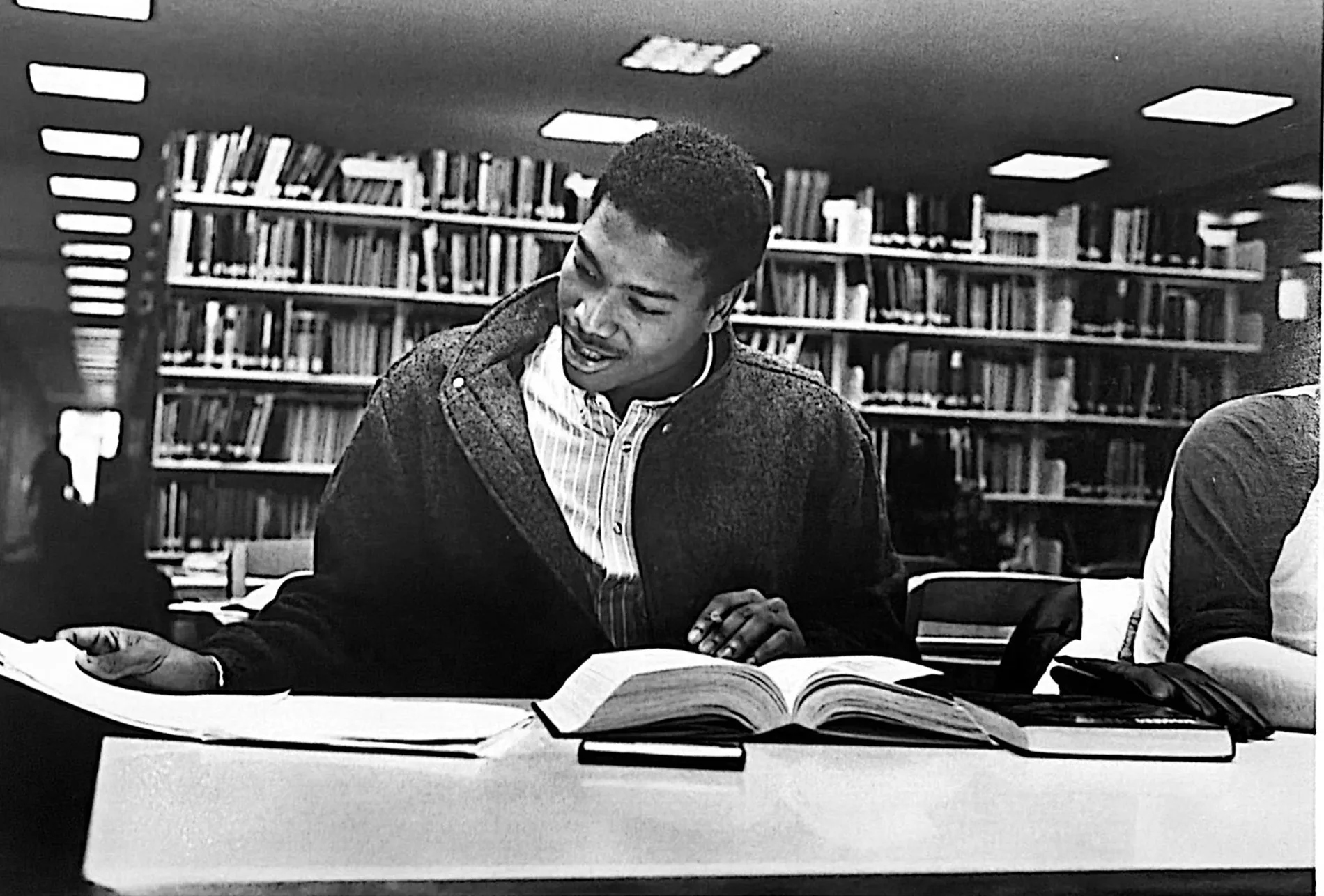
At night he played the lectures back a little at a time, a French–English dictionary open beside him. Record. Listen. Translate. Go on.
That November, Frère Emmanuel wrote from Saint-Michel. One of Coco’s letters had taken more than a month to reach him.
Madeleine had come by the school office with news of her son. His sister was doing well. Friends sent their greetings. A whole community, folded into an envelope.
Brewer High School · March 14, 1986
He came to tell two French classes about Senegal and about arriving in America. Their teacher asked him to stay. By the end of the day, about 150 students had listened.
Other schools asked for him too. The student who had hidden behind headphones was becoming someone people wanted to hear.
“a student first, and an athlete second”
James H. White, principal, Center Drive School · June 1986
V The court · 1985–1990
Orono, 1985 to 1990. It began with a winter spent mostly waiting.
1985–86The first winter
A stress fracture in August. Then a first glimpse: six points and three rebounds against La Salle. Then another injury. The player everyone had been waiting to see spent most of that season getting well.
1986–87The second
Before regular practice, Skip Chappelle worked with him alone. One skill, then the next. A pass caught cleanly. A move understood. On January 31, 1987, against Colgate: seventeen points, eleven rebounds and a win.
1987–88The third
January 15, 1988 · evening
Skip Chappelle has told the team he will step down when the season ends.
As he is leaving his office, Coco comes in.
He has come to say thank you.
He looks for the words, and then he is crying. His coach is moved, too.
January 16, 1988 · The Pit
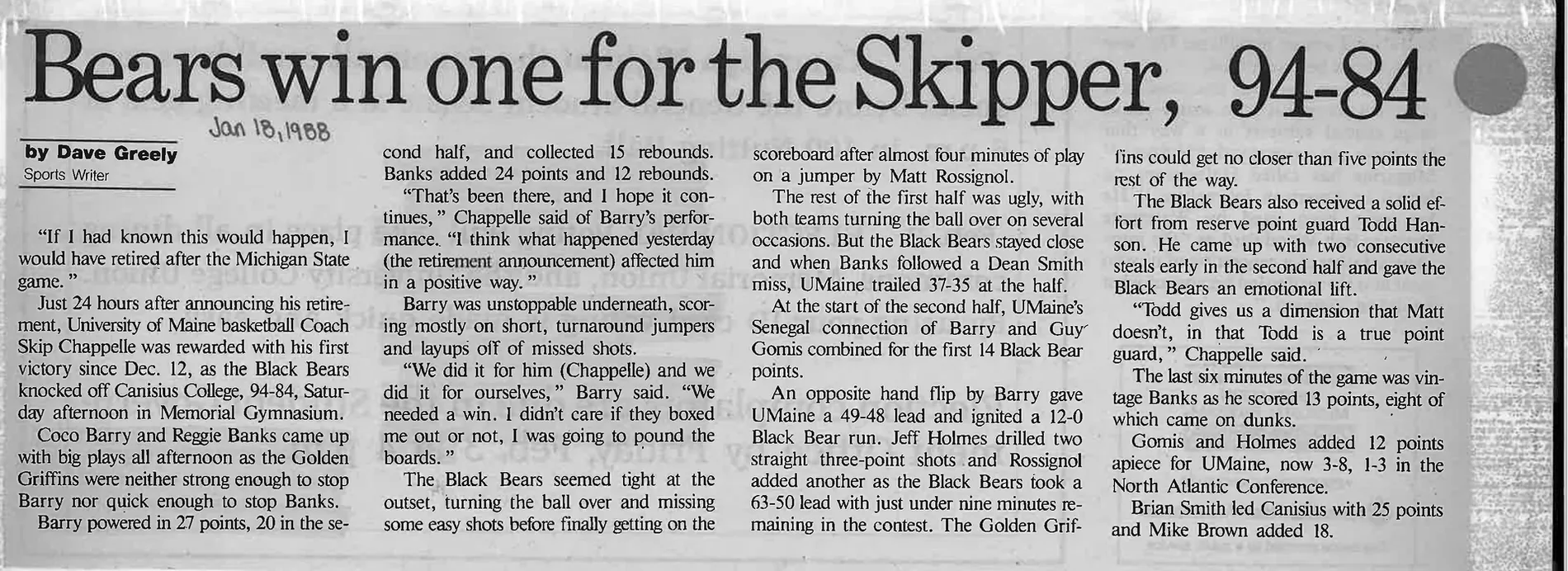
“He’s been my backbone here.”
Coco, on Skip Chappelle
1988And it lasted
Three wins in a week. Forty-nine points, thirty-eight rebounds.
The conference named him Player of the Week for the second time. By March he had 253 rebounds in twenty-seven games, and he led the North Atlantic Conference in rebounding. A rebound is a small, repeated act. Across a winter, those acts became something lasting.
1988–89The fourth
A new coach. A faster game. A seat on the bench when the ball went up. He used the wait to study the other team.
“It doesn’t matter who starts the game.”
Coco · January 1989
On March 4, 1989, he came off that bench for fifteen points and nine rebounds. Maine beat Vermont by two, and six straight defeats were over.
1989–90The fifth
There was still basketball to play and coursework to finish. The season brought a fourth varsity letter, and a class year: 1990.
Ninety-seven games.649 rebounds.Four varsity letters.
Forty-nine games live on in the clippings. Points rise above the line; rebounds fall below it. Where a page gave no number, the game is a small notch.
PointsRebounds
On film
These exist on film or tape. A copy has to be requested from the holder.
VI Around 1990
John Benoit and Skip Chappelle, who helped bring him to Maine. Guy Gomis, who built a life there beside him. All in one frame.
A degree in political science. With Guy, an African Students Association of thirty-five members, with Coco as its vice president. In Dakar, he had once imagined a club where people could share their countries. Now it existed.
The recorded lectures, the dictionary, the extra hours: all of them are in this picture.
VII Canada · From 2004
The court was no longer the center of the working day. People still were.
Stores first, then regions, then national accounts. At every step, the same work: helping other people grow. In 2019, nearly three decades after Maine, he went back to school.
A place kept for the photographs still to come.
“a passion for cultivating trust-based relationships”
Greg Bedard, colleague
Years earlier, he had needed someone willing to repeat an explanation, open a door or wait while he found his words. Care received, remembered and offered onward.
✦ The album
Open books. A room shared with friends. A laugh caught before it disappears.
Twenty-one chapters, from Dakar to Montréal.
LookThe photo albumsFamily, school, basketball and the everyday.
DiscoverArticles & letters137 clippings, letters and papers, each with a guide.
FollowThe seasonsAll forty-nine game accounts, winter by winter.
ExploreThe whole archiveAll 337 photographs and papers.
These photographs and papers come from the family’s archive, cropped and sized for the screen. Selected portraits are gently animated with AI, then settle back into the original photograph.
Kept with care by his family